Wednesday, January 31, 2007


Monday, January 29, 2007
Sunday's Sermon
“Living the Love”
the Rev. David C. Bocock
January 28, 2007 AM
the Rev. David C. Bocock
January 28, 2007 AM
• 1 Corinthians 12:1-13
Yesterday and today, there are countless thousands of men and women, both young and old, protesting against the war in Iraq and marching for peace in our nation’s capitol. Our own parish secretary is there now. All of these folks have gathered to remind our President and the nation that, gone is the time for more violence in Iraq and now is the time to pursue situations where peace can occur, but not at the expense of an increase of troops in Iraq.
Many Americans have grown weary of our President’s War in Iraq because many feel that it is no longer, or perhaps never was, a war that was in the best interest of the American people. As more and more people scrutinize the President and as the death toll in Iraq grows higher and higher, many of us are questioning the reasons for beginning this war in the first place.
Suddenly the majority of Americans no longer trust our national leadership. Why do you suppose that is? While there may be many reasons, this morning I would like to highlight one of them.
But before I do that, we should look at the lectionary readings for today.
The Apostle Paul is writing to the church at Corinth in direct response to a question that they had asked Paul to answer in a previous correspondence. With the new Gentile Christians gaining momentum in Corinth, a city of many gods and idols, these new Christians want to better understand the role of their church and how they were to effect their community with the Gospel of Jesus Christ.
They felt outnumbered and overpowered. How could a small group of Christians make a difference in a large metropolitan city of pagans and various religions whose teachings ran a polar opposite to the new fledgling religious sect.
Paul wrote to them to say that individually that didn’t stand a chance. No one person, working on their own, could make a difference. But collectively, that was a different story. Only by standing together and where each person utilizes and compliments with each other their special gifts from God, would they be able, as a community of believers, to challenge, confront, and dismantle the systems of abuse in Corinth. And God gave us special gifts to do just that.
Paul explained these gifts by focusing on three major points:
1. All our spiritual gifts come from God—the one source of all our power.
2. God gives each of us different spiritual gifts so that we must depend on each other rather than with one person having all the gifts. With one person with all the gifts, human nature would have us worshipping that one instead of serving each other. It is for this reason that all spiritual gifts are meant to help others. (1 Cor 12:7)
3. Love that is living is that which keeps us continually attentive to the needs of others—and our gifts are meant to facilitate our love. Love that is selfish, in contrast, is love that expects others to serve our needs or us. In other words, Love isn’t meant to be a tool of manipulation or used for our self interest.
Spiritual gifts are given, not for the purpose of one person determining what is best for others, but so that others can determine together what their best course of action should be.
Our system of government is supposed to work the same way. In America, we live in a Republic where we elect leaders who think and do what we hope we would do, if in the same situation. In our Republic, we vote for Senators and Congress-people to push the laws that we believe in. Sometimes our opinions change over time even after we make laws, and when that happens, we have the power to amend our decisions.
When a person or a group of persons then, make laws that run counter to what we hope they would do, there is trouble.
Over the last few years, new laws have happened upon us in the name of national security and the fight over the war on terror.
As a result, our government now has expanded powers to:
1. read our mail without a warrant
2. invade our personal lives through our email and our phone conversations…again without a warrant.
3. arrest and detain us without counsel
4. torture and abuse prisoners with impunity
These laws, while questionable and probably with the America’s best interest at heart, actually can be abused if the wrong people have our worst interests at heart.
And more and more people are getting scared about it. And for good reason. And the potential for abuse scares us. And, when secrecy abounds, mistrust and fear also reign.
There is also trouble when anyone, who does things without fully explaining their intentions, causes us to wonder about their motivations while also trying to figure out what is going on.
For instance, secret laws are being swiftly enacted, meetings behind clothes doors happening more frequently, and news outlets being fed its news rather than actually reporting on it.
When this happens, few people are trusting the powers because the powers are evading accountability—It is almost like Jack Nicholson on the stand in a military court, that we’re not being told the truth because they think we can’t handle the truth.
Because of evading accountability, we’re left only with speculation as minds and truth run amuck and we lose the cohesiveness of a people with great talents between us, to fix the trouble that has befallen us.
Such can be the problem in a local church too. This is why God gives different gifts to different people. And each person is supposed to use their gift in a way that benefits others. When a person’s gifts are not being utilized or recognized, others assume they have the gifts they don’t possess.
If a church thinks that only a few gifts are necessary, they apply the gifts of a few for the whole church. When this happens, authority is abused, and mayhem can result. Or, members can feel underutilized, and leave to find a place where their gifts are utilized. So God set up a system of accountability—where offices are in place to ensure that each person and each gift complements the other.
Here in our church, we have the office of Trustees, and Deacons, and Christian Education. We also have the office of the Pastor, the personnel committee, and the Pastoral Relations Committee. We have set up accountability so that no one person can abuse their gifts to the detriment of another.
As our Scripture explains, God understands the possible abuses of power that exist. We understand it too. This is why it remains essential that, whether we’re talking about spiritual gifts or laws that enable a bunch of people to live together, that we understand that transparency and accountability remain core values that we strive to maintain. This is the basis for the Apostle Paul’s exhortation that gifts are given to complement the gifts of other believers. Everyone must first know what their gifts are and then, when they do, they must work together if they are to successfully confront the challenges that they face.
In doing so, a successful congregation is living the love of God that is meant to strengthen them for whatever challenges that lay ahead. Whether in a city of pagan religions or in a nation confronting war, neglecting this mindset of how we’re to work together can destroy our national integrity as fast as it can rend useless the gifts and talents of the members of a local congregation.
** Extemporaneously given at the end of the sermon (so I am working from memory here) **
This is why, more than ever, we need to pray for our church and national leaders. We need to pray for both our church leaders and our President. We need to pray for our other elected leaders that they may see past the temptations of power and moral superiority and find ways to help address and eliminate the problems that now plague our nation and our world. Let us pray together now—for our leaders, our church, and all of us together.
Friday, January 19, 2007
Letter from John Thomas
 In response to President Bush's Jan. 10, 2007, address calling for an escalation in the number of U.S. troops in Iraq, our UCC General Minister and President, the Rev. John H. Thomas, has released on Jan. 11 the following Pastoral Letter:
The growing violence in Iraq, the enormous suffering being experienced by the citizens of Iraq, and the anguish of countless American families who have lost beloved sons and daughters to death and horrific injury calls for profound lament and repentance, not for stubborn commitment to the unilateralism and militarism that has been the hallmark of our failed policy in Iraq. That is why the President’s speech is not only politically disappointing, but morally deficient as well. The deceptions and arrogance which launched a war that brought Iraq to this place of pain and anguish and that have alienated the United States from so many of its friends must be acknowledged as more than strategic mistakes; they must be confessed as the core of the immoral justification for a war that failed to meet the criteria for a just war and that, as a result, cannot achieve the goals of a just peace.
People of faith are not and must not be naïve. The reality of evil is very much a part of our world. It is evil that must be restrained. The bipartisan Iraq Study Group recognized this and called for a diminishing but more strategic military force to be joined by a new and aggressive regional diplomacy that would press all in the region – our friends and enemies alike - to take responsibility for the evil they condone or in which they are complicit, and to join together across ideological and national interests to restrain the violence that threatens all. Such an approach lacks the seductive appeal of a grand “war on terror,” the morally convenient but suspect naming of an “axis of evil,” or the notion of an epic ideological battle between the forces of democracy and oppression. Instead, it requires a much more honest view of the world that calls for coalitions that are real rather than illusory. It requires the humility to acknowledge that we cannot impose our solutions by military force alone, and the courage to take initiatives even with partners we find threatening.
The President’s course ignores this, calling for unilateral troop escalation in a place where additional troops have, in the recent past, simply escalated the violence, and for a growing reliance on the Iraqi government that has been far too complicit in the volatile sectarian politics that continues to fuel the violence and undermines the capacity of U.S. troops and Iraqi security forces to restrain it. It is a course that fails to provide a credible challenge to other regional players, including
As we approach the annual observance of the birth of Dr. Martin Luther King, Jr., we are challenged by words he spoke forty years ago at the
We are now faced with the fact that tomorrow is today. We are confronted with the fierce urgency of now. In this unfolding conundrum of life and history there is such a thing as being too late. Procrastination is still the thief of time. Life often leaves us standing bared, naked, and dejected with a lost opportunity... Over the bleached bones and jumbled residue of numerous civilizations are written the pathetic words: "TOO LATE." There is an invisible book of life that faithfully records our vigilance or our neglect. "The moving finger writes and having writ moves on..." We still have a choice today: non-violent coexistence or violent co-annihilation.
The war in Iraq which has so preoccupied us at the expense of meaningful attentiveness to the tragedy of Darfur, the unresolved conflict between Israel and Palestine, and the crushing poverty faced by so many in the world, confronts people of faith with the urgency of today. It is the urgency of a prophetic imagination that offers a vision of the world far richer than the one we have been offered, a future secured by aggression and greed. And we are called to the urgency of prayer – prayer for the people of Iraq, prayer for our own soldiers and their families, especially those who grieve, prayer for the church and in particular for the small and vulnerable Christian community in Iraq, prayer for our leaders that they may listen with humility and act with wisdom. Thus may history not judge us, “too late,” and may the oft sung words of the first preacher who graced the pulpit where King spoke inspire:
“Cure your children’s warring madness, bend our pride to your control. Shame our reckless, selfish gladness, rich in things and poor in soul. Grant us wisdom, grant us courage, for the facing of this hour, for the facing of this hour.”
Wednesday, December 20, 2006
Rufus Singing O Holy Night
Rufus Wainwright and his family hosted a special Christmas sing this past week at Carnegie Hall. As technology allows, there was someone there who recorded Rufus singing in French, O Holy Night. Turn up your speakers, this is beautiful.
Monday, December 18, 2006
Questions Couples Should Ask...
 ...before they get married or partnered up. I found this interesting article on the website of the NY Times. The article has a list of 15 questions married couples should ask (or wish they had) before getting married. If you haven't already answered these questions, maybe now's the time.
***************
Relationship experts report that too many couples fail to ask each other critical questions before marrying. Here are a few key ones that couples should consider asking:
1) Have we discussed whether or not to have children, and if the answer is yes, who is going to be the primary care giver?
2) Do we have a clear idea of each other’s financial obligations and goals, and do our ideas about spending and saving mesh?
3) Have we discussed our expectations for how the household will be maintained, and are we in agreement on who will manage the chores?
4) Have we fully disclosed our health histories, both physical and mental?
5) Is my partner affectionate to the degree that I expect?
6) Can we comfortably and openly discuss our sexual needs, preferences and fears?
7) Will there be a television in the bedroom?
Read the rest of the questions by going here.Thursday, December 07, 2006
A Religious Test?
 Last week, Rep. Keith Ellison, a Democrat from Minnesota, who is the first Muslim ever elected to the US Congress, has asked that for his swearing in, he be allowed to swap the Bible out for the Koran, as the book he makes his oath on. As you can imagine, conservatives across the country have exploded in fury over his request. Citing their belief that America is a Christian nation, one religious leader went so far as to say that doing such a thing would "undermine Christian civilization." Such an argument sounds familiar for many LGBT folk.
And yet all these conservative zealots forget that America is a nation free of religious tests and a melting pot for many religions. The idea of this melting pot imagery gets lost when one person or ideology thinks everyone needs to share it. Instead, we are bunch of "we's" and not a bunch of "I's".
So, I had planned on writing something about this but instead found two others who wrote very good retaliatory posts. You can find them by going here and by going here.
God's In-Box
 Have you ever wondered what God's Prayer In-box must look like? Go here to see a screen shot on his/er computer screen. By the way, the link opens up a .pdf file.
Friday, December 01, 2006
$30 of Food?
 Here is an interesting blog about a man who spent only $30 for food during the month of November. He wrote about his experiences and reminds us all how much we spend on things we probably don't need.
Tuesday, November 28, 2006
Proud to be a UCCer
 John Thomas, the President of the UCC, wrote a brilliant mini-history of the United Church of Christ. I found it by checking out the UCC's blog over at i.ucc.org. He also wrote to remind us that, in his opinion, "it is better to be a divided church who stands for something than be a united church that stands for nothing." As the UCC is gearing up to celebrate our 50th Anniversary of the merger of the Congregational Christian Church and the Evangelical and Reform Churches, Thomas writes about that history as well as about what the UCC has stood for, both historically and more recently.
I would encourage you to go pour yourself a cup of coffee, take off your shoes, and scoot up to your monitor for a wonderful and encouraging read. It'll be one of those things that may make you say to yourself when you're finished, "Gee, that was really inspiring; I am really proud to be a UCCer."
Monday, November 27, 2006
Advent 1 is Coming Up
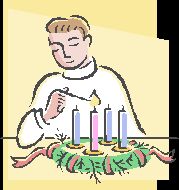 Beginning next Sunday, we will begin our new season of the liturgical year with the observance of Advent 1. Last Sunday, November 26 finalized the end of our past liturgical year culminating with the celebration of Christ the King Sunday. Next week we begin all over again the story of Jesus as both our Savior and the Christ.
Did you know that when we follow the Revised Common Lectionary that if we remain true to its Scriptural suggestions, we will preach and read through the Bible every 3 years? This is why many churches and denominations use the lectionary: to help educate our church members and help them become biblically literate.
Another way we help you to learn the Bible is to observe the various cycles in the church year. You will know when we are in a different cycle by the color of the altar and pastoral vestments. On Sundays, we have certain colors displayed on the altar, the pulpit, and the lectionary stand. And, you will notice that I wear a particular colored stole that usually matches the colors you see elsewhere. Each color represents a different cycle.
Here are those colors. There is blue, which is a new color for the season of Advent (although many folks still use the color purple), Purple for the season of Lent, White for Easter and special occasions in which we celebrate weddings or Christ the King Sunday. The color red for Palm Sunday, the Passion of Christ, the day of Pentecost and for special occasions in which God either comes down in a dramatic way or for denominational occasions such as an ordination. We use the color green for the season of Pentecost and for Ordinary Time (the time between Pentecost and towards the end of the liturgical year when nothing fancy is going on. We use the color black for Ash Wednesday (not all UCCers celebrate Ash Wednesday but we do) and Good Friday.
As we enter the season of Advent, you will notice something different all through the 4 Sundays in Advent. We will be doing something different in the services and I will speak more about that next week after we have observed the Lord's Supper. And, during the Lord's Supper we'll be doing so in a unique way that we observed last month when we sang the liturgical responses rather than only reading them as we normally do.
I am looking forward to the season of Advent and beginning again the joy of experiencing the Christian journey of faith with you.
Another Conversation about Branding
 In a continuing conversation many of us are having at church, the idea of branding our church has been a recurrent theme. Having now established our identity missional statement, we now move forward in communicating that statement in our ministry activities. The idea, of course, is to use the statement as a way to 'stay the course' in our pursuit of finding ways to reach out to church-seekers and also as a way to 'remind us all' why we are here.
In such a conversation, branding becomes an underlying theme. And with branding, we should keep asking ourselves: Who do people think we are? Are we remaining true to who we say we are? And while these are thoughtful and good questions to keep asking ourselves, we also need to be careful when asking these questions. In our desire to remain true to our identity, is it possible to lose the ability and elasticity to change when necessary?
In a post written about the struggles with brand marketing that Starbucks Coffee is having, one writer talks about the dangers of branding without entirely chucking the entire concept. Go over and read the post and let us ask ourselves how branding can help us without being tied to it.
Monday, November 20, 2006
The Results of the Identity Survey
 The Good News Team (GNT) has done it! After examining and reading all of the responses to the congregation questionnaire, they have determined the answers to the questions: Who are We? Why are We Here? and Who is Our Neighbor?
Here is the summary statement of those three questions:
We are a loving, open-minded, caring, dedicated church on a journey to learn, laugh, discover, grow, worship, and praise God together. We invite anyone who needs help on life's journey to experience our hospitality.
As many of you know, the GNT has been working diligently with these questions in order for them to ensure that when we advertise ourselves to our various communities, we are who we say we are. This idea stems from the understanding of the philosophies of branding and marketing.
When it comes to branding and marketing, we are not negating the power and authority of the Gospel, rather we are distinguishing ourselves for the benefit of our prospective member. In this way, we hope that a prospective member will have an understanding of our identity and will be able to make an informed decision as to whether or not their gifts and talents will make a good fit with us. Given that there are many churches that a prospective member may choose to attend, branding and marketing our church as honestly and sincerely as possible will help grow our church accordingly.
When you see a member of the Good News Team, be sure and thank them for the dedication and hard work.
Monday, November 13, 2006
Nervous Pastors
 I would like to offer a special thanks to my friend Paul who directed me to a post from Mark Driscoll regarding his protective guidelines for a pastor. Driscoll, a post-emergent pastor, wrote his post in response to the Ted Haggard mess and writes to warn all other pastor's to be careful to protect themselves from sexual temptation. Go here to read Driscoll's list. You'll need to scroll down a page.
 His list is both frightening, kinda freaky, and yet, clear that we all need to be careful when it comes to temptation. Admittedly, I was aghast at how he looks at women, as if they are all seductive vixens. And, blaming Haggard's wife for Haggard's fall is one example of how scapegoating only serves to strengthen an argument from the person talking about it and has next to nothing to do with the real issue of the person or thing that person is referencing.
Okay, so all that aside, take a look at Driscoll's Safeguards and let me know what you think.
Subscribe to:
Posts (Atom)


